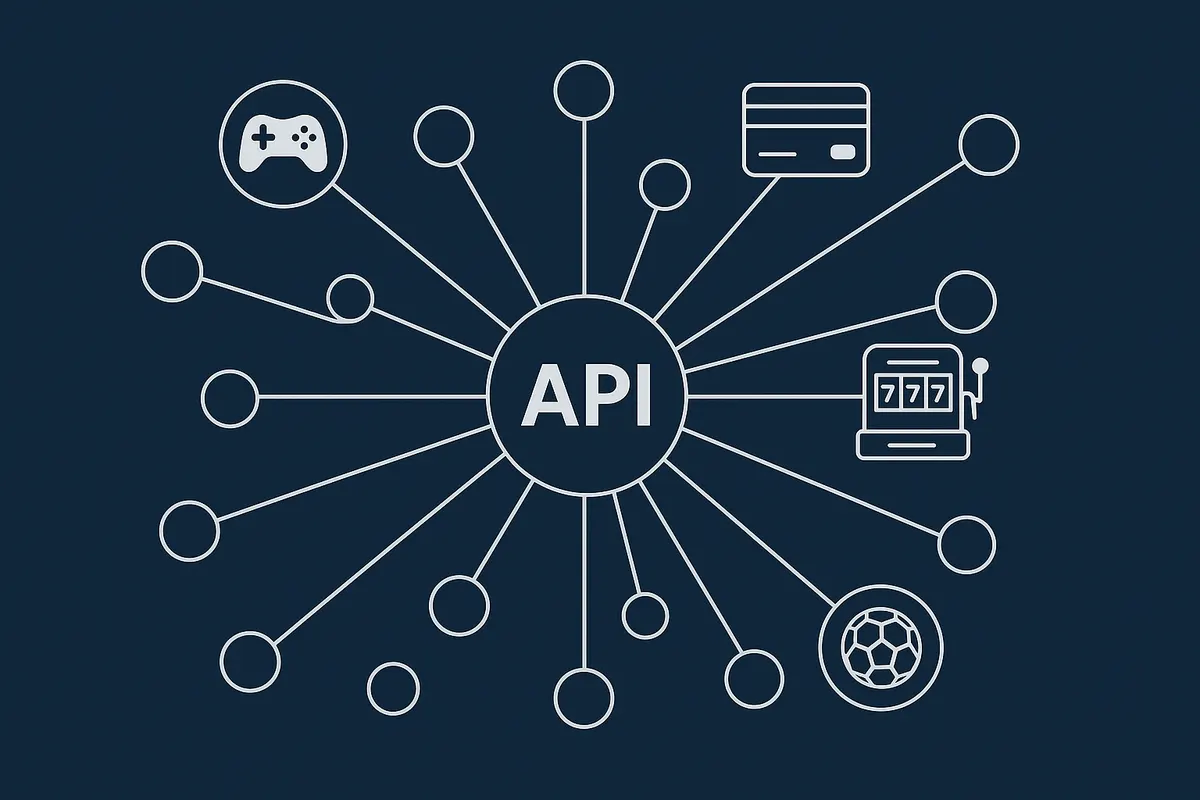
Alea’s newest product line is not a slot studio. It is a sportsbook, launched with FIRST.bet, sitting alongside payments and jackpots in the same commercial pipe the company built to distribute games. For an aggregator, that is a genuine change of job description, and founder Alexandre Tomic summed up the reasoning bluntly at SBC Summit Lisbon: aggregation has to become broader than games.
That line is worth unpacking, because casino content aggregation is the plumbing behind almost every online casino lobby you have ever scrolled. If the definition of “content” is changing, so is the way operators buy technology, and eventually so is what players see on screen.
One integration, thousands of games: what aggregation does today
Casino content aggregation is the practice of bundling games from many separate studios behind a single technical connection, so an operator integrates once instead of dozens of times. The aggregator handles the individual provider contracts, the API work, the game launch protocols, the reporting, and usually the ongoing certification headaches per market.
The game-first model most operators run on
A modern casino lobby can list thousands of slots, live dealer tables, crash titles and regional card games such as Teen Patti or Andar Bahar. Almost no operator built that library by signing thousands of deals. They signed one or two, with aggregators, and inherited the catalogue.
The commercial logic is simple. Each direct provider integration costs development time, legal review, testing and maintenance, and it has to be repeated every time the operator enters a new regulated market with different technical standards. One integration that delivers a hundred studios turns a multi-year roadmap into a quarter of work.
How an aggregator sits between providers and operators
Think of three layers. Providers build games and run the RNG and game servers. The operator owns the player account, the wallet, the bonus engine and the front end. The aggregator is the translation layer in the middle: it normalises game metadata, routes bet and win transactions to the operator wallet, standardises free-round and tournament calls, and pushes back the reporting an operator needs for finance and compliance.
Done well, that layer is invisible. The player clicks a thumbnail, the game loads, the balance updates. Nobody thinks about the distribution network that made it possible.
The problem Tomic is pointing at
Here is the catch with a game-only pipe: it solves one integration problem beautifully and then stops. The operator still has to build or buy everything else separately, and each of those pieces comes with its own API, its own contract, its own reconciliation and its own vendor relationship.
Why game-only aggregation runs out of road
Game libraries have also converged. When most aggregators can offer broadly similar catalogues from the same major studios, “we have 12,000 games” stops being a differentiator and starts being table stakes. Content volume becomes a commodity, and the competition moves to whatever sits around the content.
Alea’s response, as Tomic describes it, is to widen the definition of content. The company is expanding beyond game aggregation into payments, jackpots and sportsbook, and has said it will grow its jackpot offering further while presenting the products at events including SBC Summit Lisbon and SiGMA Rome. The sportsbook vertical went live with FIRST.bet, and the current focus is taking that solution to other operators.
The market reality behind the argument
Tomic’s other point is about how uneven markets have become. Brazil remains one of Alea’s more important markets despite higher taxes, heavier marketing costs and a more demanding compliance load, and he argues operators cannot lift a European playbook and drop it into Brazil, where player behaviour and trends shift quickly.
That matters for aggregation strategy. If local conditions differ this much, an operator entering a new market needs more than a game feed. It needs payment methods that locals actually use, promotional mechanics that suit local behaviour, and reporting that satisfies the local regulator. A distribution partner that only ships games leaves the hardest parts unsolved.
What else can travel down a content distribution pipe
Once you accept that “content” means anything an operator can plug in and monetise, the list of candidates for content distribution gets long.
Operational tools and services
- Payments. Deposit and withdrawal rails, method routing per market, and the reconciliation that goes with them. In practice this is the single biggest source of player complaints, so owning the integration is valuable.
- Promotional engines. Free rounds, tournaments, missions and leaderboards that work consistently across every studio in the catalogue rather than only the handful that support them natively.
- Jackpots. Network or operator-level jackpot layers applied over third-party games, which is exactly the vertical Alea says it is expanding.
- Reporting and analytics. Game performance, cohort behaviour, margin by segment, plus the regulatory reporting each licence demands.
- Compliance modules. Market-specific limits, responsible gambling tools, session reminders and self-exclusion hooks that need to behave identically everywhere.
Player-facing layers
- Sportsbook as an additional vertical inside the same platform and wallet.
- Unified bonus balances so a promotion works on slots, live tables and sports without the player learning three sets of rules.
- Gamification that follows the player across the whole lobby rather than living inside one studio’s games.
What changes in casino platform technology
Broader aggregation pushes work out of the operator’s platform and into the aggregation layer. That is a real architectural decision with trade-offs, not a free upgrade.
| Layer | Game-only aggregation | Broader aggregation |
|---|---|---|
| Games | Aggregator | Aggregator |
| Jackpots and tournaments | Operator builds, or per-provider | Aggregator layer over the catalogue |
| Payments | Separate PSP integrations | Routed through the same partner |
| Sportsbook | Separate vendor and wallet work | Additional vertical from one partner |
| Reporting | Games data only | Casino, sports and payments in one view |
| Main risk | Integration sprawl | Vendor concentration |
For operators choosing a partner, the evaluation shifts. Catalogue size and revenue share still matter, but so do questions a game-only checklist never asked: how quickly can the partner support a new market’s payment methods, does the promotional engine work across every studio or only the cooperative ones, can jackpots and tournaments be configured without a development ticket, and what is the exit path if the relationship sours. Concentrating games, payments and sportsbook with one supplier is efficient right up until you need to replace them.
Platform scalability cuts the other way too. A smaller operator that cannot staff a large in-house tech team gains the most from buying more of the stack pre-integrated. A large operator with its own platform may want the games and nothing else.
What players actually notice
Players never see a game aggregation platform, but they feel its limits. Bonus terms that apply to some games and not others, a tournament that mysteriously excludes half the lobby, separate balances for casino and sports, a withdrawal that stalls because the payment provider and the platform disagree about a transaction. Most of those are integration seams, not deliberate design.
When the promotional, jackpot and payment layers live in the same place as the games, those seams get easier to close. A free-round campaign can run across studios. A jackpot can sit over a wide slice of the catalogue. Casino and sports can share one wallet and one bonus balance. That is the practical upside: fewer inconsistencies, not new kinds of magic.
What does not change is the maths. Aggregation moves content around; it does not touch RTP, house edge or volatility. A 96% RTP slot returns about the same long-run average whether it arrived via a direct integration or through a distribution network, and every jackpot or tournament layer is funded from wagers, usually by shaving a fraction off base game returns. Better plumbing makes a casino easier to use, never easier to beat. Set deposit and loss limits, treat gambling as paid entertainment, and use the self-exclusion and cool-off tools your operator is required to provide.
Common questions
What is casino content aggregation?
It is the distribution of games from many providers to operators through a single API integration, with the aggregator handling provider contracts, technical maintenance and reporting.
How does game aggregation work in practice?
The operator connects its wallet and player account system to the aggregator once. The aggregator then routes game launches and bet and win transactions between the operator and each provider’s game server, translating between different technical standards.
Why expand beyond games?
Because game catalogues have largely converged and the remaining operator pain points sit elsewhere: payments, promotions, jackpots, sportsbook and market-specific compliance. Tomic’s argument is that an aggregator that only ships games is solving the easy half of the problem.
What content do aggregators distribute beyond games?
In Alea’s case, payments, jackpots and sportsbook. More broadly, the candidates include promotional and tournament engines, analytics, and compliance tooling.
The interview this analysis draws on was published by Focus Gaming News.